












White-headed Ukrainian — buy or sell



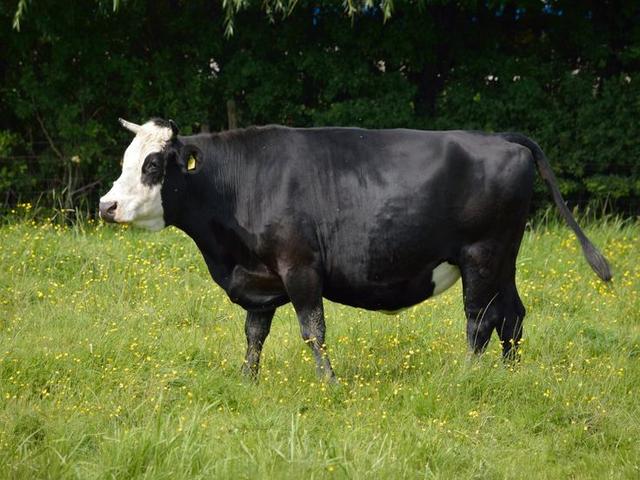
History of the breed. At the end of the 18th century, a new breed of cattle was developed in the vicinity of Zhytomyr and Korosten in modern-day Ukraine. This breed is based on the local Polessian cattle, which was crossed with bulls of the Groningen Dutch breed. In the Netherlands, Groningen cattle are primarily raised for milk and meat, while Ukrainian cattle have been subjected to selection aimed at improving their milk productivity since their inception. This breed of cattle, known as the Ukrainian White-headed, originates from the northwestern part of Ukraine. It was developed in the late 18th to early 19th century by crossing Dutch cattle, particularly the Groningen White-headed breed brought by Mennonite settlers, with Ukrainian Grey and Polessian cattle. In 1926, a State Breeding Book was established to account for and preserve the White-headed Ukrainian cattle. Exterior. Representatives of the breed are characterized by sturdiness and density of build, have medium size, a deep but not wide chest, a light and dry head, a long neck, poorly developed musculature, and a thin skeleton. The color is black or red with a white head and lower body, and spots around the eyes are possible. The udder is medium-sized with properly positioned teats; rudimentary teats are often found, but the front quarter is poorly developed. Key measurements: height at the withers — 127 cm, depth of the chest — 68 cm, diagonal length of the body — 165 cm, chest circumference behind the shoulders — 181 cm, pastern circumference — 18.6 cm. The average weight of bulls over three years old is 750–810 kg, with a maximum of 1100 kg; the weight of cows at five years old is 450 kg, but some individuals reach 700 kg. Conditions of keeping. Keeping cows on a farm can become a reliable source of profit, as well as provide the owner with fresh dairy products and meat. However, this is only possible with proper care, correct feeding, and the creation of suitable living conditions for the cows.
Log in to learn more
Sign inWhat to feed
Ration. In winter, cows weighing 450–500 kg require 6–8 kg of quality hay per day, 2 kg of which can be replaced with spring straw. Hay, especially grass-legume hay, is an important component of the winter ration for dairy cows. Juicy feeds are given at a rate of 6–8 kg per 100 kg of weight, offering two to three types. Large cows with high milk yields can be given up to 50 kg of juicy feeds per day. Sugar beet is given no more than 12–15 kg per day, divided into three portions, and feed beet up to 30 kg. The same amount of potatoes can be given instead of sugar beet. It is beneficial to include 2–8 kg of feed carrots, 6–8 kg of silage, and 2–3 kg of haylage per 100 kg of weight. The amount of concentrates depends on the daily milk yield: up to 10 kg — up to 100 g per 1 kg of milk, from 10 to 15 kg — 100–150 g, from 15 to 20 kg — 150–200 g, from 20 to 25 kg — 250–300 g, more than 25 kg — 300–350 g. In summer, green grass and compound feed are sufficient.
Physical parameters
Male Weight: 120–140 kg
Female weight: 110–127 kg
Male height: 750–1100 cm
Female height: 450–700 cm
Habitat Range
Belarus
Latvia
Lithuania
Ukraine
Åland Islands
Frequently Asked Questions
How much does White-headed Ukrainian weigh?
Adult animal: male — 120–140 kg, female — 110–127 kg.
How tall is White-headed Ukrainian?
Height at the withers: male — 750–1100 cm, female — 450–700 cm.
Where does White-headed Ukrainian come from?
Country of origin — Ukraine.
Where is White-headed Ukrainian bred?
The breed is common in: Belarus, Latvia, Lithuania, Ukraine, Åland Islands.
What should White-headed Ukrainian be fed?
Ration.
Q&A
No questions yet. Ask the first!
Log in to ask a question